
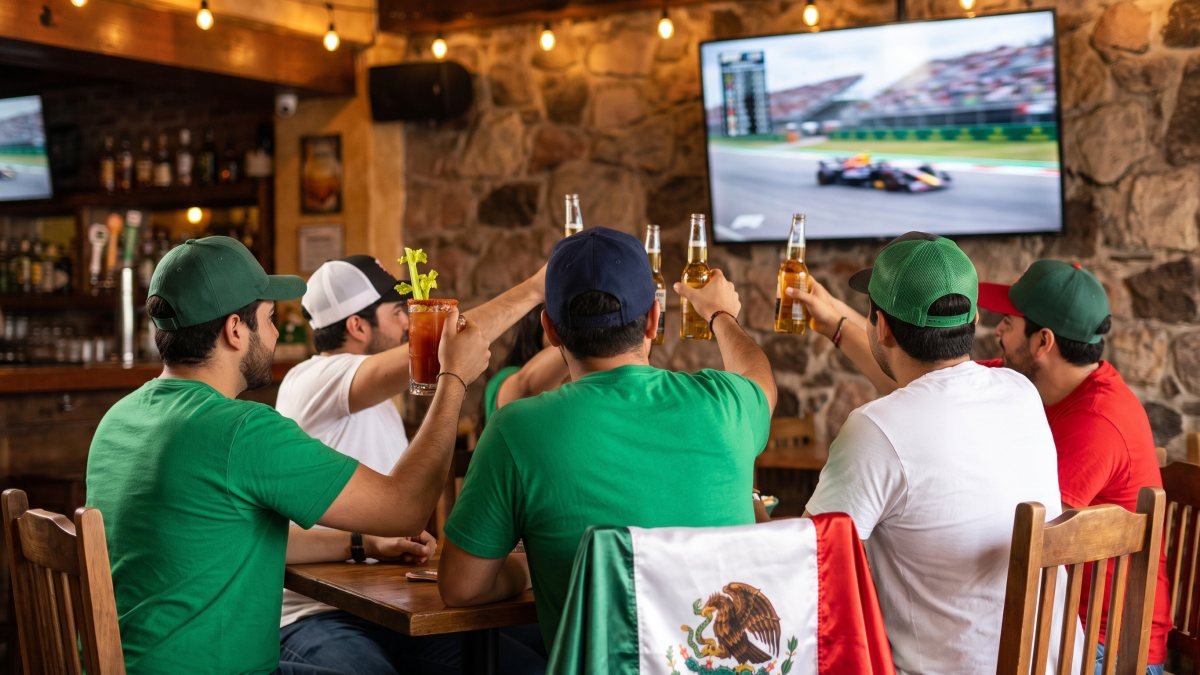
Few things bring a table of Mexicans together like a Formula 1 Sunday with Checo Pérez on track. For years, the driver from Guadalajara turned race mornings into a national ritual: coffee, screen, flag and a roar every time he made a pass. In 2026 the ritual came back with a brand-new story: Checo returned to the grid with Cadillac, the sport's debut team, in the same year Formula 1 rolled out new cars and new rules. And at Guicho's Sports Bar, here in Nuevo Vallarta, every Grand Prix is lived with screens all over the bar, a clamato in hand and the Mexican flag hanging where everyone can see it.
This is our guide for the Checo fan on the Riviera Nayarit: his comeback with Cadillac, why this season is unlike any other, how race times land in Nayarit, what's coming in the final stretch of the year and what to order at the bar while the lights go out.
Checo's comeback: from the sabbatical to Cadillac.
To understand why 2026 is so exciting, you have to remember where he came from. Sergio "Checo" Pérez arrived in Formula 1 in 2011 with Sauber and built a career spanning more than a decade on unexpected podiums with Force India and Racing Point, including that unforgettable first win in Sakhir at the end of 2020. Then came the Red Bull years: more victories, the runner-up spot in the 2023 world championship and a constructors' title celebrated alongside Max Verstappen.
At the end of 2024, after a difficult season, Checo and Red Bull parted ways, and 2025 was a year without a seat. Many thought the story was over. It wasn't: Cadillac, the new American team backed by General Motors, picked him as one of its two race drivers for its debut season, alongside Finland's Valtteri Bottas. Two veterans with more than enough experience to build a team from scratch.
That's the big draw of this season: Checo isn't fighting for a championship, he's building something. Every point Cadillac scores in its first year is a milestone, and every race where the team moves up a spot on the grid is a small victory that gets celebrated here at the bar like a podium.
2026, the year Formula 1 changed completely.
Checo didn't just come back to a new team: he came back to a new Formula 1. The 2026 season introduced the most ambitious technical regulations in more than a decade, and understanding them makes every race more fun to watch.
Smaller, nimbler cars
The 2026 cars are shorter, narrower and lighter than the previous generation. The goal is closer racing, with cars that can follow each other more easily and overtake without relying so heavily on strategy.
Active aerodynamics
The old DRS is gone. The cars now have movable front and rear wings that change position between the straights and the corners, opening up new ways to attack and defend. For a driver with Checo's experience in race management, it's fascinating territory.
Power units that are half electric
The power units split energy almost evenly between the combustion engine and the electrical system, and run on 100% sustainable fuel. It's a huge change that reshuffled the manufacturers and opened the door for new teams like Cadillac to arrive at a moment when everyone is starting from zero.
In short: in 2026 nobody is guaranteed anything, and that makes every Grand Prix full of surprises and opportunities for the teams coming from behind.
What's coming in the final stretch of the season.
With the European summer in the rearview mirror, the calendar enters its most appealing stretch for fans on this side of the world: the circuits of Asia and the Middle East, the races in the Americas and, of course, the Mexico City Grand Prix.
The Mexico City Grand Prix: the date of the year
In late October, the Autódromo Hermanos Rodríguez comes alive again with the local hero on track. During Checo's Red Bull years, the Mexican GP became one of the biggest parties on the calendar; with his return, Mexico City will be buzzing once more. If you can't be at the track, the second-best place to live it is a bar full of Mexicans in front of a screen, and that's what we're here for.
The Americas: Austin, Brazil and Las Vegas
The races on this continent are the most convenient to watch from Nayarit: afternoon start times, no early alarms and the bar at its best. Austin and São Paulo are two circuits where Checo has delivered great drives, and Las Vegas, with its night race among the casinos, is pure spectacle.
Abu Dhabi: the finale
The season wraps up in December in Abu Dhabi. For Cadillac, reaching the end of its first year as a consolidated team will be the real goal, and for fans it will be time to take stock of a comeback that seemed impossible a year ago.
Your spot for the next Grand Prix
Screens all over the bar, a proper clamato and snacks from the formation lap. Book your table for Checo's race.
Reserve on WhatsAppFormula 1 race times from Nayarit.
Formula 1 races all over the planet, which means every Grand Prix lands at a different hour in Nuevo Vallarta. Here's how the calendar generally shakes out:
| Region | Approximate time in Nayarit | The plan at Guicho's |
|---|---|---|
| Europe | Mid-morning on Sunday | Race-day breakfast: chilaquiles, coffee and a clamato with the formation lap |
| Americas (Mexico, Austin, Brazil) | Sunday afternoon | The perfect slot: a full meal and a packed bar |
| Las Vegas | Saturday night | A night race with the bar at full tilt |
| Asia and the Middle East | Very early morning | For the most devoted; otherwise, see you for the replay and the post-race debate |
Exact times change with every Grand Prix, so before each race check Guicho's Facebook page, where we post what we're showing and when. And if you have a question about a specific weekend, message us on WhatsApp.
What a race day feels like at Guicho's.
A Formula 1 race lasts just under two hours, but the full ritual is longer. This is what makes a Grand Prix at the bar different from watching at home:
Screens all over the bar. The race on the main screens and, when it overlaps with an NFL Sunday or Liga MX, the other games on the rest. Nobody misses what they came for.
A real crowd. Formula 1 Sundays bring together locals from Bucerías, Mezcales and Nuevo Vallarta, expats who have followed the sport for years and tourists who discover, to their surprise, what Checo means to Mexico. When he makes a pass, the whole bar roars.
The family-friendly vibe. Come in your team gear, with the kids or with your partner. F1 is the perfect Sunday plan for the whole table, and the bar is casual and relaxed, the way a beach-town sports bar should be.
The location. We're at Blvd. Nayarit 137B, Local 5, minutes from the marina, the hotels and the golf courses. If you're staying in the hotel zone, you don't need to cross over to Puerto Vallarta to find somewhere to watch the race. The map is in our location section, and our guide to where to watch live sports in Nuevo Vallarta has the rest of the details.
What to order on a Grand Prix Sunday.
A race is eaten in stints, just like a tire strategy. From Guicho's menu, this is our recommended pit stop:
Formation lap: Guacamole ($180) and Mexico City-style Esquites ($160). To get started while the grid lines up. The guacamole is made to order with chips, and the esquites come with epazote, butter and grilled bone marrow.
First stint: The Wings (400 g, $205). Pure drumsticks in Buffalo, BBQ, Mango Habanero, Parmesan or Lemon Pepper. The ideal order to share around the table during the first twenty laps.
Pit stop: the tacos. The Shrimp Taco ($145), El Gaonero with grilled New York steak ($150), the Campechano with Talpa chorizo and arrachera ($140) or the Pork Shank Taco in adobo ($145). One taco between safety cars.
For those staying until the checkered flag: The Guicho's ($310). Three hundred grams of Angus beef with Mennonite cheese, bacon and grilled onion on a brioche bun, with fries. Or The Hawaiian ($315) with grilled pineapple, for those celebrating in style.
To toast: ice-cold beer and a proper clamato. The clamato is the official sidekick of the morning races; ice-cold beer belongs to the afternoon ones. And the artisan ice cream ($60) closes the afternoon after the podium.
Beyond Checo: why F1 is worth it in 2026.
Even though Checo is the reason most of us turn on the TV on Sunday, the 2026 season has a lot more to offer. The new regulations shook up the grid, the big teams had to reinvent themselves and the smaller teams have opportunities they didn't have two years ago. There are young drivers pushing the veterans, new duels in every race and a sport that got back the unpredictability that made it great.
For anyone just getting into Formula 1, it's the perfect time to get hooked: we're all learning the new rules at the same time. And for those who have followed it for years, it's the season the sport became unpredictable again.
So now you know: every Grand Prix Sunday, the Mexican flag hangs at Guicho's. You bring the cap; we bring the screens, the snacks and the cold beer. See you when the lights go out.
Frequently asked questions.
Where can I watch Checo Pérez's races in Nuevo Vallarta?
At Guicho's Sports Bar, Blvd. Nayarit 137B, Local 5, Nuevo Vallarta. We show the Formula 1 Grands Prix on screens all over the bar, in a casual, family-friendly setting minutes from the marina and the hotels.
Which team does Checo Pérez drive for in 2026?
Cadillac, the new American team backed by General Motors that made its Formula 1 debut in 2026. His teammate is Valtteri Bottas.
When is the 2026 Mexico City Grand Prix?
In late October, at the Autódromo Hermanos Rodríguez in Mexico City. It's the most anticipated race of the year for Mexican fans; check Guicho's Facebook page to confirm the broadcast and start time.
What time are F1 races in Nayarit?
It depends on the circuit: European races land mid-morning on Sunday, races in the Americas in the afternoon, Las Vegas on Saturday night, and Asia and the Middle East very early. Exact times change with every Grand Prix.
Can I reserve a table for a race?
Yes. Message us on WhatsApp at 322 199 9535 to book your table. For the Mexico City Grand Prix and the end-of-season races it's best to reserve ahead.
What changed in Formula 1 in 2026?
A new rulebook arrived with smaller, lighter cars, active aerodynamics instead of DRS, power units split almost evenly between combustion and electric power, 100% sustainable fuel and the arrival of Cadillac as the eleventh team.